
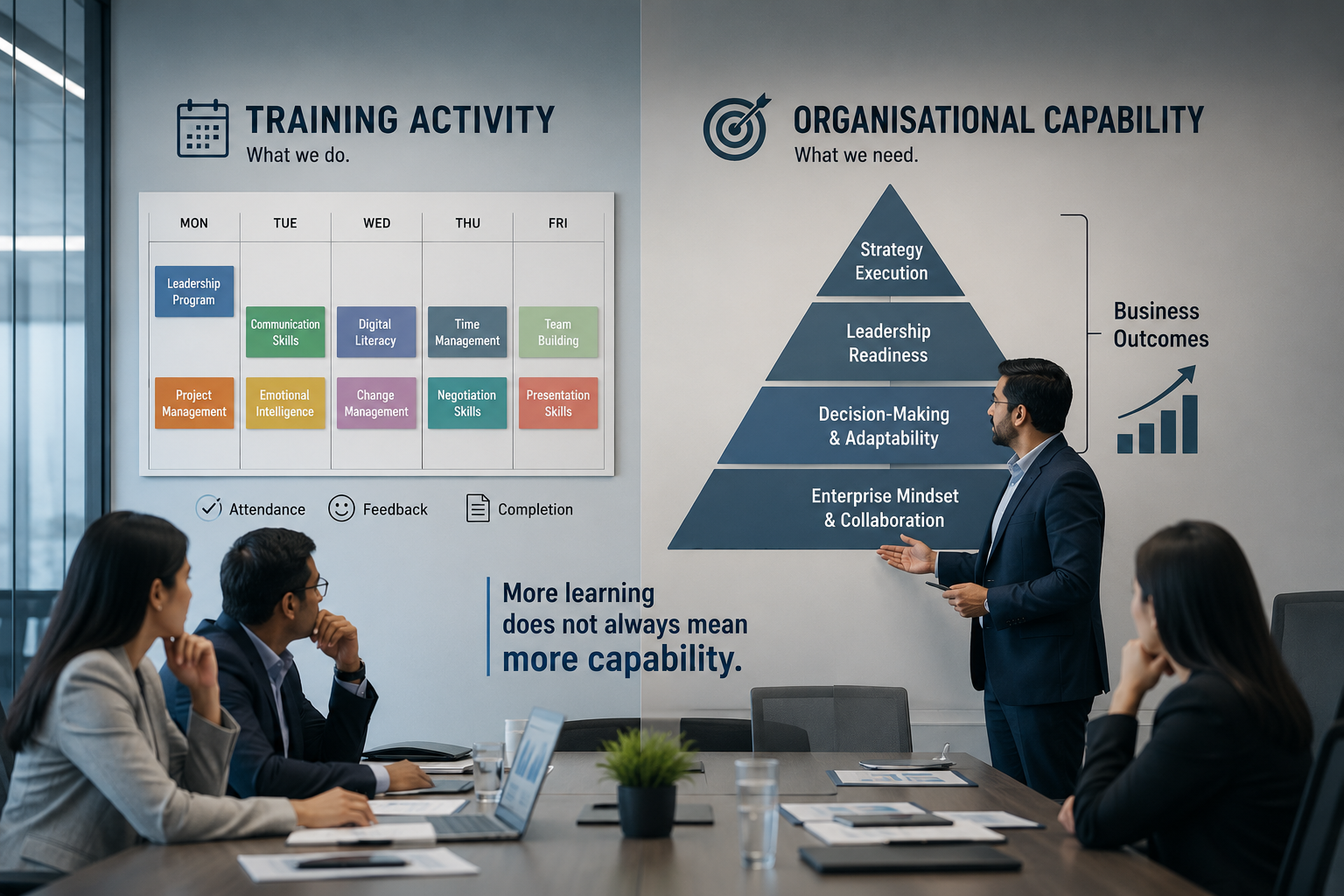
For many organisations, learning has become easier to deliver than ever before. Digital platforms, executive education, curated content and specialised training providers have significantly expanded the range of development opportunities available to employees. Yet despite this growing investment, many organisations continue to face persistent gaps in leadership readiness, strategic decision-making, execution and workforce adaptability.
The underlying issue is often not a lack of learning. It is the disconnect between:
what organisations teach and what the business actually needs people to do differently.
A full training calendar can demonstrate organisational commitment to employee development. It does not necessarily demonstrate organisational readiness. The distinction is becoming increasingly important as businesses navigate growth, transformation and changing workforce expectations.
The Training Calendar Is Not a Capability Strategy
A traditional learning agenda typically begins with programs, topics and participation targets. Organisations identify leadership courses, communication workshops, functional training or executive education programs and then measure participation, completion and feedback. These measures are useful, but they answer questions about learning activity rather than business capability.
A capability strategy starts somewhere else. It begins with the organisation’s strategic direction and asks what people must be capable of doing to deliver it. If an organisation is entering new markets, for example, its leaders may need stronger strategic judgement, cross-functional collaboration and decision-making capability. If the organisation is undergoing transformation, leaders may need greater change leadership, digital readiness and the ability to manage ambiguity. The development agenda therefore follows the business strategy rather than operating independently of it.
This represents a fundamental shift from managing a training calendar to managing organisational readiness.
When Learning Becomes Disconnected From Business Reality
The limitations of a generic learning model become particularly visible during periods of growth or transformation. Consider an organisation preparing to scale rapidly. Its leaders may need to manage larger teams, make decisions with greater speed, collaborate across functions and operate effectively in situations where there is no established playbook. A conventional leadership program may address some of these subjects, but if the learning experience is disconnected from the organisation’s actual challenges, its relevance can diminish quickly.
Participants may complete the program, respond positively to the sessions and demonstrate improved knowledge. Yet the underlying business problem may remain unresolved. The issue is not necessarily the quality of the program. It is that the intervention was designed around a topic rather than a business problem.
Capability building becomes meaningful when learning is connected to the decisions, behaviours and challenges that leaders encounter in their actual roles.
From Knowledge Transfer to Capability Transfer
This distinction is particularly important in executive education. Knowledge provides leaders with concepts and frameworks, but capability determines whether those concepts can be applied effectively in complex business situations.
A leader may understand the principles of strategic communication and still struggle to communicate a difficult business decision. A manager may understand delegation and still remain overly involved in operational work. An executive may understand innovation frameworks and still find it difficult to move an initiative from an idea to implementation.
The difference lies between knowing what to do and being capable of doing it in context.
Modern organisations therefore require development approaches that move beyond knowledge transfer towards capability transfer. Learning becomes more valuable when leaders are given opportunities to apply new thinking to real organisational challenges, make decisions in realistic situations and receive reinforcement as they translate learning into workplace behaviour.

Start With Diagnosis, Not Content
This is why effective capability building should begin before a curriculum is designed. The first question should not be, “Which leadership program should we run?” It should be, “What organisational challenge are we trying to solve?”
The answer may reveal a need for stronger enterprise thinking, more effective strategic communication, greater decision-making readiness, improved cross-functional execution or better preparation for leadership transitions. It may also reveal that the capability requirement differs significantly across leadership levels.
This diagnostic perspective at the centre of Edex’s capability-building approach, emphasising the importance of understanding business direction, leadership gaps, execution challenges and future capability requirements before designing the intervention.
This approach changes the role of learning from responding to perceived training needs to addressing the capabilities required for business performance.
The Future of L&D Is Capability-Led
For L&D leaders, this creates a more strategic mandate. The question is no longer simply how many people were trained or how many programs were delivered. The more important question is whether the organisation is developing the capabilities required for its next stage of growth.
This means connecting business strategy with capability requirements, identifying where critical gaps exist, designing targeted interventions and creating opportunities for leaders to apply and reinforce what they learn.
In this model, L&D moves from being a provider of learning experiences to becoming an enabler of organisational readiness.
How Edex Helps Organisations Move Beyond the Training Calendar
At Edex Educom, Capability Building Interventions are designed around organisational priorities rather than generic learning requirements. The approach brings together business-context understanding, capability diagnosis, customised executive education and applied learning to help organisations strengthen the capabilities that matter most to their growth and transformation agenda.
The objective is not to add another program to an already crowded training calendar. It is to identify the capabilities the organisation needs, understand where those capabilities are currently constrained and design interventions that help translate learning into stronger leadership and business execution.
Because the question is no longer how much an organisation is training its people. The question is whether it is building the capability required to execute what comes next.
Build capability around your business reality with Edex Educom.
👉 Explore our interventions: www.edexeducom.in
📩 Write to us: connect@edexeducom.in